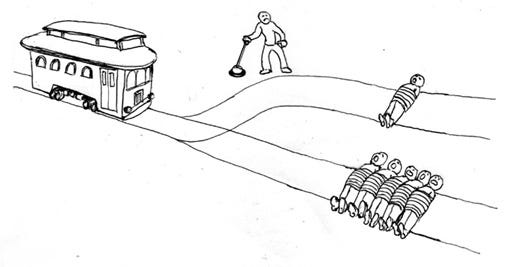
Where do you put your story-altering decisions?

Of the games I played, most of them mostly rely on making the player select one of two or more dialogue options. A few others like some from the Fallout series just gives you quests you can start and working with certain factions just makes it so you progress on their storyline instead of other's.

I'm thinking of exploring major and minor story-altering choices from more subtler ways like wandering in different sections of the map, triggering events in different orders which results in a butterfly effect. Main drawback aside for making the project scope bigger, I think is that if a player wants a certain result they may have to resort to a guide if my story-altering decisions are obfuscated and well-hidden.

How have you approached this and what are your thoughts?
if a player wants a certain result they may have to resort to a guide
I feel like this is a necessary link.

I totally understand the idea of it. I loved it in this random ps1(2?) game I played where the game was only 1-3 hours long but had, I kid you not, 14 major endings with a total something like 200 variations of them based on your actions.

But for an rpg, any sort of long story really, it seems a bit counter. It's one thing if player actions have some sway over things, but major effects being chosen by arbitrary effects gets you things like Silent Hill 2 tracking how long you look in your inventory at items to determine the ending.

And as you said, it does make the project scope bigger, possibly exponentially so.

Dialogue options are a way to give the player something to grab onto, something they can see as a 'choice' to make and effect things. Other ones are things like Pokemon letting you lose to your rival and his team changing over time based on win/loss ratio.

Maybe I'm overreacting and I do think subtly is good. I just don't think that a player should be 'forced' to use a guide to play the game. Although I do like the idea I've seen where the ending shows you what you did to cause the ending in a sort of gallery mode.
I think what we need to make sure of is whether or not a game has multiple endings or multiple plot altering choices is going to enhance the game or not. There are games that implement it and it works and there are games that implement it and don't.

Honestly if you want to avoid the player looking for a guide then you can't really have subtle choices, if you want the actions of the player to decide which party member gets permanently killed then you need to present the option with the clear intent that the choice they make has X effect. The more impactful the decision is the less hidden it needs to be, stuff like alternate endings should not be hidden outside of maybe Easter egg style endings and such.
The thing about applying butterfly effect is that there is no way a player can predict what happens during the time they made the choice that can lead to said outcome, this inevitably creates scenarios where you have to resort to guides to get the desired outcome, because said information will never be apparent to a player on a first playthrough, unless the game is designed with multiple playthroughs in mind and the player is expected to replay it to pursue different outcomes utilizing the knowledge they now possess. RPGs are (generally) long-hour games not optimized for multiple playthroughs, you'd want to avoid that if possible.

Story-altering decisions definitely do have their place in their RPGs however, but they have to be very carefully implemented in a way that will not force players to replay a significant portion of the game to undo a mistake , and the important choices should be clear on the consequences it might cause and not be obfuscated in any manner, else it becomes another entry in the Guide-Dang-It page.

Personally I also use them to decide major character's fates depends on your action, with the only real way to let them die is via deliberate inaction / intentionally making bad decisions rather than dialogue choices.
My first game has a few drastically different paths, depending on player choice, but they don't stand out much beyond being like other events, so they should feel like the natural flow of the game to people who play through it once. I don't think it's important for people to experience every path, whichever path people play should come naturally to them through the actions or choices they make.
I find having those kinds of secrets make it more enjoyable for the rare people who might replay the game and stumble across new things. It's more exciting to find stuff by playing than by reading a guide.
With everything discussed it seems with my project, it is best that what butterfly effect I will have should not affect the storyline's big picture, just change dialogue.

SIlent Hill 2 sounds like something I should look at as an example of butterfly effects actually put into practice
I want to give a sort of counter-argument to all the (admittedly good) arguments against a powerful butterfly effect...

As someone who is always interested in the power of choice in games (and often dissatisfied with some so-called 'choices') something as all encompassing as the butterfly effect has a certain appeal. (that Eve Online trailer that talks about their butterfly effect almost convinces me to play)

Now, I do agree that illogical forms of this are annoying. Stepping on a randomly chosen arbitrary tile having a far reaching effect sounds and feels wrong.

But say you plant lots of carrots, it attracts rabbits (you can catch them), which in turn attracts dangerous wolves (battles), which finally activates a certain switch in your red riding hood inspired quest.
Something like this might annoy others, but sounds interesting to me.

Obviously the possible problem is (depending on design) that people would miss content they could enjoy Without Knowing It Existed, and so it's certainly something to think hard about if It's part of a project.
Also I despise any parts of any game that requires you to find information from outside the game (guides, internet, etc). My school of thought is very much that a game should have all relevant information needed to play the game within the game. As applied to something like this... it should be clear from the beginning to expect far-reaching effects from simple actions, and it would be nice if people would be able to piece together the logical progression from action to final effect without too much difficulty...

I might have more thoughts later but don't hold your breath 😛
I'd do this for a visual novel but I despise this on a J-RPG.

I don't have a lot of time to replay RPGs. There are hundreds of game and dozens being released every week. I'd like to know what's the story inside a game and move on to the next game. If a game forces me to do this, you'd bet I'll youtube the rest of the content I miss.

The reason is mostly the logistics. To get through either branch, I have to face another grind through the same set of enemies; I might have to redo the builds I've had on my characters based on my other save (sometimes trying a new build already require several saves); and save slots in an RPG game is not that much to try things out.

Not only that, I have to sit through a set of possibly-unskippable cutscenes that I have seen before and find that little 'deviation of dialogue' that may or may not catches your eye (and most of the time, I've already seen this cutscene before over and over due to losing to the boss battle is placed in between).

These however don't exist in Visual Novel and I'd gladly replay a VN to get all of the endings. (Best of all, some VN even do mark unread dialogue, so that's another plus).
Hmm. I've researched and personally played around with story altering decisions, since it's the core design ethic in my games. I've noticed that the longer a game is, the less feasible the "big" changes tend to be since that's more dev work and you might already be exhausted from doing everything else.

So here's three handy ways it could possibly work, based on what I've learned:

Spoiler: #1: Free Actions
So let's say your game is big, the story is quite intricate, and doesn't lend to change much until the very end. What do you do then? Have your actions change other things about the world - a lot of small things that don't impact the endings.

Like maybe you had the chance to save someone from dying, but didn't know how to at the moment. Their fate is ultimately a footnote in the plot and gameplay, but maybe you liked them enough to want to bring them back. It opens up an exclusive side-quest and gets rid of an otherwise permanent tomb marker.

What if a town has no food to draw from, so you plant some crops and use nature magic to speed up the process? That's up to you.

Example: sparing Wyatt or Fergus at the beginning of Wolfenstein: The New Order. That influences quite a bit of the game, even if the overall narrative is the same.

Non-linearity in level design is another aspect, like visiting locations without their story events active or a superboss out in the open that you can visit at any time with different characters and dialogue depending on the current team.

Spoiler: #2: Signposting
Make it clear with no uncertainty that this decision will have real consequences - especially useful during a long game.

The consequences don't have to be addressed in the moment, but there has to be a sort of dread and aftermath attached to a scene that makes it obvious what you're going to do is going to change things.

Now, don't do "good choice, bad choice". That isn't a mystery and 9 times out of 10 people will choose the good option. What is a mystery is making both choices hard. The good old moral dilemma.

I personally have variations of this:

Let's say you use a powerful item that curses you, giving you unimaginable strength, but it condemns you to a bad ending or worse depending on your further actions. You have the chance to reverse it at least once, but every other use dooms you, and this is spelled out in great detail.

Due to the power of this kind of decision, it's best to plan out how this affects everything and keep them sparse so their effect is maximized.

Spoiler: #3: Complete modularity
This one you can only do if the game is short (I'm talking 2 hours or less), since it comes with too many caveats otherwise.

Every open path can lead to a different ending, and it works because the game is short enough to make it not brutal existential torture for the developer. Auto-saves and "do you wish to return to this moment" functionalities are god-sends here, with the latter being extremely useful for even long games if you can implement it without breaking the rules or lore you might have.

Hints especially make it useful to figure out what you need to do in this regard.

Undertale, for example, is short and simple enough to justify every action you can do to modify the story. There really aren't any extra systems or anything like that, so the overall experience is easier to get through.

Extra note: A functional cutscene skip and/or a "retry-when-you-die" feature helps keep the line moving when it comes to pace, so those features are must-haves if you plan to have story-heavy games.

There is one major problem: what if you're too far ahead of that moment and restarting the game isn't an option? I'd like to repeat what I said in point #3 about "return to this moment?" functionality. If you can make it work, hammer it in. It doesn't even have to be a real time travel gimmick if you don't have that kind of thing.

I like to have it as a reward of sorts. "Oh, you tried to do 100%? Well sheeit, I guess I can bend the rules a little and let you re-do that moment. I won't tell if you won't." :LZSangel:

Original thread: https://forums.rpgmakerweb.com/threads/where-do-you-put-your-story-altering-decisions.126738/