Does it really matter if they can't copyright the images if they can copyright the arrangement? I mean they can still steal other's work, make images and arrange them into a let's say comic or game and copyright that?
If you respect the art of game development in any way, please, do not use AI Art.
General DiscussionThat's not the watershed moment. It basically says that the images were allowed, the story is copyrightable, but the AI generated images weren't allowed to be copyrighted.
Like:
Which means the transformative rule still applies, aka the images themselves aren't copyrighted, but the aggregate work is. All Kashtanova would have to do is commission an artist to draw that character once and she can also copyright the image of the character. AKA, a game with AI generated images would be legally fine, for a more pertinent example.
On top of that, for big companies this wouldn't be an issue, and in fact this ruling is perfect for them. Let's say for example Mickey Mouse gets AI generated by someone. If that someone isn't OK'd by Disney they can be sued.
Conversely, if Disney makes an AI generated movie with Mickey Mouse, Mickey Mouse would still be copyrighted, the movie would still be copyrighted (because it would be a unique arrangement of frames). Or, If Disney has an artist draw a promo concept of that character it's still copyrightable is what this case establishes.
Getty images vs Stable Diffusion will be the one to look for because that deals with how AI models are formed, BUUUUTTT, the way this went seems to make it look like Stable Diffusion is more likely to win that (besides, wasn't even their image database). Artists vs all the AI generators lawsuit chose the worst possible angle from what I understand so that one is super unlikely to go anywhere.
Where we are now is that it's confirmed that, at minimum, no one will be punished for using AI Art and would still be able to copyright aggregate/transformative works that have human input.
You can't copyright something containing other peoples' copyrighted work and just have carte blanche that it's legally fine. The point is that if you can't copyright the output of these systems, the work cannot be used in commercial products.
It's done, far as I can see.
But that has nothing to do with the case you posted. It was not about AI models using other people's work or anyone else having a copyright here. The case here was basically saying you cannot copyright an image that was not made by a human, but you can copyright a whole work that contains ai geneterated images. It's about human input. The characters, the work, the arrangement of panels in this comic are all copyrightable, just not the individual images (i.e. AI generated work has no authorship, but AI generated assets can be used in authored work).
To go over from the beginning what happened here for context (mostly from memory so forgive me if I smudge some details).
The girl at the center of this case made a comic after her mother died as a sort of memorial. She used AI to generate the images for the comic, but wrote the story herself, then filed a copyright, and got it. Then the copyright office realized the art was AI generated and then removed it.
The case granted this girl's comic a copyright, granted the arrangement of images a copyright, granted the characters a copyright, but did not grant the individual frames a copyright in themselves (which is functionally irrelevant) because they were generated by AI.
Again, if you want to see whether the statement about other people's work in models has legal basis, the case you're looking for is Getty Images vs Stablity AI.
What this settles is that you can get copyrights for works containing AI content.
If you are not in the industry and don't know much about the business side of video games, maybe you shouldn't call people stupid or ignorant like this...
Afaik, commissioning famous anime/manga artists has been an established practice for anime style game genre(mostly gacha) because popular artists have so many fans, which converts into revenue everytime a new character is released in a gacha game.
Those artists aren't cheap at all, their price depends on how popular they are within the community. but the cost of hiring them is still lower than the extra revenue from their fans, it became an established business model for many years.
Of course AI isn't replacing them. Their fans mostly despise AI art and will witch hunt any company for using them since they pay to support their favorite artists. Since they are the customer, their preference makes the business decisions. If they don't like AI art and refuse to pay for AI art, game dev using AI art will hurt the revenue, not the other way around.
The one who will get replaced by AI isn't popular freelance artists who bring real revenue to the company, but likely low rank employee in a studio doing easy tasks who has nothing else to sell except their software skills.
It's fine to have personal opinions on artists, but calling everyone else "stupid" for using them successfully, it only shows how little you know about this subject.
If you know nothing about the subject. I think it's wiser to learn more about them before commenting.😅
Then I suggest you start trying AI now and replace those artists, get followers and make that money from big clients!
I doubt an untrained indiviual can THAT easily beat real professionals from my experience using AI, since the hardest part of creating art is design, not output generation. AI doesn't do design very well since the whole point of design is to look unique and different from everyone else, but AI is as generic as it possibly can.
And controlnet or img2img is tool for output precision which requires design skills to begin with. So the main limitation of AI remains unsolved.
The problem in this whole discussion is, how people view artists as a tool for output only but totally ignored the real elephant in the room which is design. This is how they start posting disrespectful comments about a profession that they know nothing about only because AI can do output now.
I am done.
AI Art honestly feels illegal. To train the bots, its creators need to first download and feed into the machine learning MULTIPLE art pieces and pictures(and yes, photos can and usually DO have copyright).
Whether or not the output is different, the mere fact the whole thing uses some one else's creations without any sort of permission from the creator should be more than enough to win a court case against them.
Honestly, at this point my experience with Midjourney - the results I was able to get without ever even trying to use AI to generate art before... I hate to say it, but while I was impressed by the tech it only made me respect people who point at AI art and say "I made this" less.
I just hope we never get to a state as developers where we think taking credit for the work of others is acceptable, be they a human being or a toaster oven for spitting out .PNGs.
Couple that with not even owning the copyright for what you are putting in your game, and the unethical "training" of these AIs on people whose art was taken against their will and/or without their consent and we're back to a big "no thank you" from me.
While I don't think anyone should be taking authorship of AI images, either, to be clear not owning the copyright to a specific image in a game is insanely common. If anyone, for a pertinent example, uses the RTP you do not have the copyright to the image that is the RTP, you can have a copyright to the game it's in, however. That also applies to DLC assets and even a lot of commissioned assets.
So, someone who isn't drawing the assets in their game themselves likely already doesn't own the copyright to those assets. If you want a copyright to a character's appearance, that would still be possible with AI art so long as someone has a human draw a rendition of the character, gives them the rights to the image, and copyright that.
This is putting aside legitimate moral debates, obviously.
still not comparable to the refinement you'd have when creating the model first and then posing it for capture and flattening.
it's OK for a one-time use, but since it lacks *definition* it'll never *sustain*
you can ask it to draw a model posed in a certain way, but from there to generate a whole spriteset? consistently? that'd require the full model, designed, specified.
yes-ish.
it's still a flattened image, not the 3D data... that's all generated at render time, in memory.
how? by taking the starting conditions (the objects, with properties, in the scene) and running the procedure: bouncing light rays, bleeding color shades, casting shadows, blurring pixels, etc.
it's comparatively a much larger set of data than simply the initial objects and the lot of instructions... which is the whole point: to simplify it.
...... how do you change the lighting of a picture, if lit pixel is color + light and you need both the original color and the lighting information to tell how much of each is adding to the final result?
if you have the original color but not the lighting (as in, a flat anime-style drawing) you can add shadows and highlights wherever you want, and that itself is simply following the procedure of actually shading the picture, which is widely known (as in, an *art*, in and of itself)... but removing the lighting from an already lit image to turn it around? that's a destruction not a transformation.
all of this, *I* analyzed and worked on, when shading the models in my signature image. That dwarf in the middle? look at the lighting on his armor, that's a light coming from the camera bouncing off a reflective surface that I painted. The original texture for that armor had the lighting baked in: a bright overcast, shading the armor from top to bottom. I had to go in, paint over the baked original glare, restore the constant sheen of the metal, and then add another layer to define the brightness, and feed all that to the render engine, to get the final product. *I* did the math for that, as I was taking the paint brush over the image and determining 'this is too dark' or 'this is too bright'. The original armor was gold. So was the human next to it. The tunic of the kid to the right side was pink. That's not pink rendered pink and repainted green... that's pink repainted green on the texture file, rendered green on the scene with a tint of blue, and flattened.
Can an AI reverse-engineer that the same way?
like I said: OK for a single use, but not dependable.
To move an arm in this case you'd have to reference a pose and a depth map.
As for extrapolating what's behind a subject, even before control net, AI inpainting has been very good at removing bystanders from photos (a use-case people have been using has been, for example, removing crowds from photos with family at attractions). In this case, it's pattern data (if AI sees X part of background, its training makes it believe that something like Y must be behind the subject), it doesn't have images in the models (since they're only 4 gb despite being trained on terrabytes of pictures).
As for lighting, it just requires a black and white picture for reference (i.e. just draw a tiny picture in the same aspect ratio as you want your output to be with white where you want bright, gray where you want dim, black where you want it darkest and thing will interpret the rest, no detail required from what I understand).
It's definitely more than I fully understand, but this extension wasn't even made by a company, just a single person.
As for an actual full 3d model, there's NVIDiA's magic3d and OpenAI's point-e:

OpenAI releases Point-E, an AI that generates 3D models | TechCrunch
OpenAI has released Point-E, an open source AI system that can generate 3D point clouds given a text prompt.
 techcrunch.com
It's not totally baked yet, of course. AI can't even do proper lower pixel art and low pixel spritesheets. Human professionals are still better and more consistent and should be the go-to for any professional project, imo.
But, that's for now. I don't think any of this goes away, and that latest case with the comic just cemented that it doesn't prevent copyright on transformative work (I.E. more than sum of parts. Like a game that uses some amount of RTP assets can still be copyrighted.)
Case to look at for what route things go is going to be Getty Images vs Stability. That's what'll determine how models can be generated... Thaaat being said the last copyright case puts it in reverse emulator territory legally, where instead of being able to provide and make emulators being legal but using pirated games not, it's the reverse where using AI art is legal but we don't know if it's legal to make an AI model that has looked at pictures without permission (It should definitely be illegal to train a model on one artist, though, but I feel like that'd take legislative action to make and also be difficult to enforce).
yeah, but that's *addition* on top of the image.
it doesn't work if the picture already has lighting, as it would need to be removed before the new one is put on.
you can't "change the lighting" in a picture that's already taken.
you may "change the coloring" or "change the mood", but *the lighting* is the sum of input color, input light, reflection, and shadow. And the more light you add to something, the whiter it becomes, and the more the color is burned out, so if you want to change it you have to restore that first.
it's still the same argument as before: all of this works for getting reference imagery, but not the actual asset to use in the game, as they are engineered pieces built for purpose.
It actually does work with a picture that has lighting, though? You can even change the reflections individually with inpainting. Unless I'm misunderstanding what you mean by lighting
To be clearer: you take an image you have (or don't, you don't need to), with lighting, let's say it's day time. Then you get a black block, paint in some white and gray, throw it in the AI and out comes the same image, the same composition, but different lighting, brightness, and shadow. You can make day into night and vice versa. For reflection that's just something you can specify.
I think your point is that the AI doesn't have a totally full understanding of what it's doing, which I agree with that point.
I mostly agree with the current state of things but, I'd say that for image editing this is very useful.
that's impossible, because to make another shadow you have to remove the original by putting color in it!
color that is there as a result of the bounce of light onto the material (or rather, isn't, because, shadow... it is, on the other side of the shadow)
can it take this picture and make it a clear day overcast?
I just googled that specifically "portrait, hard light"
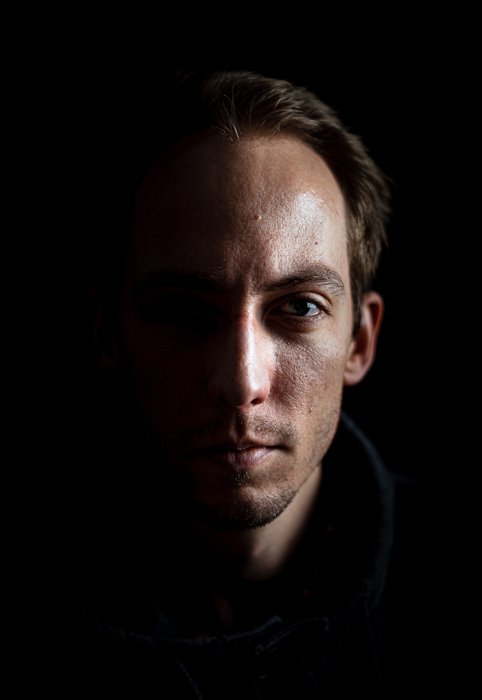
hard light, means hard shadow... and hard shadow means missing color and volume.
"remove" is the wrong word ... ai doesn't "change" things as we understand it,
rather it "redraws" the entire thing with the new set of inputs ...
yeah.
that's what happens when you let people use definite words to imply negatives.
"shadow" isn't really "shadow" but rather "not-light".
I said the other day in youtube, that 'muggle' is only valid when you see the world from Harry Potter's perspective: a kid in the world of magic... but that magic is IN the real world, so the abnormal thing here is 'magic' and 'muggle' is not 'non-magical', is 'normal'! XD
not-light would be darkness ...
shadow is the phonomenon, the human brain interprets, when lit areas meet with unlit areas ... it is not "not-light" per se but rather a difference in light intensity ... becouse shadow can have light in it
I mean, commissioning art for what is a glorified slot machine makes sense. Gacha aren't so much "video games" as "gambling addiction enablers".
If your sole refutation of my argument is "Slot Machine style games need to commission art!", then it's a failing proposition.
What I tend to know about "the business side of video games" is the same I tend to know about business in general.
People pay for commission for "single images", typically. So, it's a useful business practice when that's your goal. It isn't useful for Video Game design because either you'll be cheated as an artist, or you will be cheating the person doing the commission. It is far better to simply hire an artist based on thier resume, portforlio, and then retain them for the duration of the project. With a sensible contract (I wouldn't pay hourly, I'd write it up as if they were "bidding" for their contract like tech people do. "I need X by Y, with A and B stipulations for reworks, error fixes, and consultations. Quote me how many hours that you think that would be, tell me what you want paid per those hours, and that's what you'll get. If it ends up being more hours than what you quoted, then that's your fault. If it ends up being less hours than you quoted, then that's on me.". This makes the most sense from a business standpoint when it comes to "commissioning" artwork for a game you do not have an assembled team for, with artists drawn from a bunch of rank amateurs).
Again, only young children or the economically ignorant have no idea why doing "Commission" for a video game project is typically a bad idea (you appear to be one of those as after I already explained how and why you'd get cheated in a previous post, you decided to tell me I knew nothing of the business. I REALLY hope you read contracts when you make commission, 'cause knowing that little about you right now, I would DEFINATELY rip you off for all you are worth, and you'd never see it coming).
When you know anything about the business, you know it's smarter to only do small bits and pieces as "commission", and not most of your project.
Yes, but not really. EA is the most hated video game company on the planet... They're still in business, despite how many people whine and complain about them and despite their actual criminal acts.
I'd wager those fans that "despite AI Art" are probably a small and vocal minority. My guess would be that the vast majority of the end users don't care if it was generated via AI or not. They probably don't even have a "favorite artist" to feel enough sympathy for to complain about the AI Artwork.
I think for any conversation to continue on this front, we'd need to agree to only talk in the realms of reality and bring facts and figures to the field. Like, if you're a part of an insular tumblr/reddit/twitter group that cares (a few thousand people, at best), and their works sell millions... Well, then your opinion on it really isn't going to impact anything.
Most consumers only care about end product. They don't typically care how end product made it to market. How it got there is too far removed from anything else in their lives for them to give a crap.
You're being disingenuous here. That's never what any of my posts were about. Rather than explain it to you (which means reiterating my points again), I'll just have to go back through my posts and reread them. If there's something you don't understand, ask me, and I'll clarify it.
Commission for video game art is actually not that smart of a business move. Feel free to try to prove to me how you think it is, but I'd wager I know more about making and holding onto money than you do at this point.
There is a reason most studios hire an "art team", rather than "commission art pieces". One of these is economically viable and easier to control productivity, costs, and quality. The other is not.
As stated before (not sure why you ignored that point, please fill me in why you ignored it, so I can better understand your point of view):
I really only care about the aspect of this based upon how it affects the industry as a whole. I don't care about how it works much in the first place. I don't use it, I don't really have an intent to use it, and I view it as PURELY a tool to be used.
I care about the people saying, "waahhhh, it's going to replace my job!" and "waaahhh, it's not actually arrrrrttttttttttt!!!!".
Those portions of the topic are more interesting to me. Especially since there are levels of nuance, philosophy, ethics, and "personal opinion" to be debated on such things.
I simply have no interest in how it works, overall. If people want to use it, good for them. If it's more economically viable to use it than current artists in the biz... fantastic, love to see technology march forward and obsolete jobs that are pure busywork. If people say not to use it because it has limitations, then fantastic, I hope those limitations go away in the future.
Otherwise, I have non-interest in the subject at large. You can ignore anything I say that has to do with ignorance on that portion fo the subject. If I claim AI Art can do things that you know it can't, you can ignore me or correct me, and we'll move along. I know nothing on the subject, will not really debate you on it if you know more than I do, and will simply make stupid jokes in response to such corrections. Again, you can ignore me based upon my ignorance of this subject. I know I don't know anything about it. I told you I don't know anything about it. What is there to be gained by trying to prove I don't know anything about it... other than you have a massively inflated ego?
Generally, If I don't know something on a subject, I just don't talk about it much, because I can contribute nothing of use or interest. If I make assumptions and assertions based upon incorrect data on a subject I know nothing about, then I'll just admit I know nothing about it, concede the point to you, and move along. Or, as I typically say "I stand corrected", or "Yeah, sorry, I don't know anything on the subject."
I have no interest in AI Art, as I've stated before. I have no interest in creating artwork in general. My canvas is the written word. If I could program an AI to write my books for me in 20 hours, then I'd be on top of that so fast.
If all I had to do was proof-read and highlight sections for rewriting... that would be FANTASTIC.
Heck, if other Indie devs just had to pull up an AI program to write their dialogue and give them a story... I think that'd be AMAZING. I'd endorse the crap out of that.
1. It means I'd never really ever have to suffer through a terrible story or cringe dialogue ever again. Or, at least, such instances would be rare.
2. It would mean that more people could bring their visions into reality so that I could experience them.
If AI Artwork goes that way, then I'm fine with that. Sounds good to me. Wide Scale Accessibility sounds fantastic to me.
But, in terms of "making money" the way you suggest... Yeah, I don't care. That's not what interests me. I have an actual job to make money. I don't need to be "rich" except in order to "never worry about money again", and I don't care enough about that to want to give myself headaches and stress to achieve it.
Especially if that means I attain some level of fame from doing it. Then count me out. I have no interest in any sort of fame what-so-ever. I prefer to live like "The A Team". If you need help, if you have no-one else to turn to, and if you can find them... maybe you can hire... The A Team.
Or... something like that.
If only the important people know of me and value my skillset, that's good enough.
My joys lies elsewhere. Not in "making a lot of money", "being famous", or "being the best".
How does that song go?
"When I'm old and grey... I'll look back on my life and say... give me one more day... and still I'll never do anything."
Or, maybe it's better phrased as:
"I think never is enough, yeah never is enough. I never wanna do that stuff. I think never is enough, yeah never is enough. You never have to do that stuff."
That may be the point, but it often isn't the reality... Lots of artists output looks very largely the same and almost indistinguishable from others. It's the difference between someone truly creative and someone who "just learned how to imitate creativity".
Which is, funny enough, the main reason people claim, "nothing is truly new, everything has been done!". I mean, yeah, when everone lacks actual creativity and has only been taught to mimic it... there sure aren't any new things out there anymore.
Yeah, I don't know anything about this, or care about it. I'll just concede the point since you know more about it than I do.
I think even artists ignore this. Except, most of us call it "aesthetics", and from a lot of the artwork I've seen across the internet... there aren't many that have an eye for aesthetics (I mean, look how many put characters on blank backgrounds, dead giveaway, or static poses with no action going on...).
You can even spot this lack of aesthetics in the vast majority of AAA games. We have Deus Ex with its "lemonade filter" on the one game. We had that whole like decade of games that used "gunmetal grey" and "dirt brown" as their entire color palette. We have current artists in games who clutter their environments with a hundred million objects to the point that it looks like a hurricane designed the area, rather than it represents anything approaching what reality looks like.
For me, if the AI outputs the same nonsense as most artists do... then I fail to see the point of the argument. If we're arguing that most artists know how to do "design", and AI can't, then you'd need to prove that the artists actually know how to do design. If businesses can replace them because the work is "the same", then it says much and more about the profession of "artist" than it does about "people's lack of understanding about design". It says that such artists likely have inflated egos.
Now, if those businesses are wrong and can't actually do without those artists... then they go out of business. The market has a way of correcting for such errors. What is desired by consumers and what is profitable by businesses is what sticks around. Anything that isn't desired by consumers and isn't profitable, inevitably goes extinct.
After all, the decline of good stories, good characters, and good gameplay in video games is a direct result of the consumers saying, "I want more realistic and amazing looking games!", so everything is dumped into "making it look good" and then "the marketing" and everything else suffers.
The market wants games people can use to benchmark their PC's and be "Wowed" by how things look. They don't seem interested in "a coherent and gripping story", "solid and fun mechanics", or "fantastic character arcs". So... lot less games with those things these days. 😀
The market speaks. People vote with their wallets.
I would say this is the problem in our society, or at least in my country. I don't know how other country works. Most small businesses here took a random image from google and put it in their banner like it was nothing. Someone even took someone's drawing and sell them as merchandise. There had been multiple cases of it. Some people might be "kind" enough to remove the item, and some people are just stubborn to keep it while arguing with the original artist. Just because the majority doesn't care, we should normalize this. We raise awareness. To spin your word, this is probably not what you meant but this is like saying "Most players don't care if your game uses the ripped assets. Those fellow devs are the vocal minority".
Now, whether AI-generated images are going to solve this societal issue. We are finding out.
I mean, it can in the practical sense. But, I think we're quibbling over pedantic terminology here and not necessarily fully disagreeing? I mean, yes, the AI would be guessing at the details that are hidden by the shadow but it would be a pretty accurate guess with a controlnet. And, yes, it would be effectively redrawing pixels like a photo editor in different colors.
Don't really understand the point here, though? If it's about not really being a 3d model where the program understands all the details, I did link you to examples of AI rendering full 3d models?
my point being that it's not the same having an initial input of model and color over which to paint the lighting afterwards, than to have the whole setup of model, color and light, and pose the model while maintaining the other two.
that modelling AI can only make solid models, with the rendering power of 3Dstudio 2 from 1999. The coloring on them is a variant of vertex coloring, not texture mapping.
and the general point being, that when you want an asset for a game, you'll want consistency, in case you have to modify a little bit of it to make it 'just right' for your case, while asking the AI to modify it might discard the whole model and render you something completely different.
and in the end, if you're going to generate a lot of content from it to then cut it and mash it to your liking, might as well learn to use the software for good, make your own content, and dispense with the AI altogether.
you have much more freedom when you work the program yourself, and the final product will have your personal touch everywhere.... it'll stand out as being your own, and the first question that anyone will ask will not be "is this AI generated?", they'll have to look really hard to spot it.
sometimes you'll have to state "I made this with AI!" because it wouldn't look so.
like I said: OK for a quick solution, but not for a serious project, much less for gaming.
the reason being, that 3D modelling for games is a compound art: is modelling, painting and animation. You won't get a working solution from one AI, and if you have to mix several solutions to match, you're defeating the purpose of using the AI, which is to save you work.
I suppose the best way to train these AIs to really learn the basics of anything, would be to teach them music theory.
if anyone was to develop an AI that could compose music from scratch by learning the music theory we've been studying for 400 years, the learning model could then be applied to images and 3D models... but that's the thing: you'll have to deconstruct the *practice* of painting and modelling into a bunch of single sentences and make it *theory*.
Original thread: https://forums.rpgmakerweb.com/threads/if-you-respect-the-art-of-game-development-in-any-way-please-do-not-use-ai-art.153340/