No, there's not sufficient resolution. Besides if they snapped off, thet'd be on the ground directly below where they were mounted. From a direct overhead view (the highest resolution position) it would be impossible to tell whether they were still mounted or on the ground... even if you could see them.
Phoenix Mars Lander.
Our Solar SystemThanks for the update Wayne.
There's now this also.
On Wednesday 6th January 2010, MRO HiRISE imaged the Phoenix Mars Landing site.
Below area surrounding Phoenix Mars Lander.
The lander is camoflaged in CO2 frost deposits. The CO2 ice is slowly subliming in the northern Martian Spring Sun.

Full Article here.
Planetary Photojournal article here.
Andrew Brown.
There's now this also.
On Wednesday 6th January 2010, MRO HiRISE imaged the Phoenix Mars Landing site.
Below area surrounding Phoenix Mars Lander.
The lander is camoflaged in CO2 frost deposits. The CO2 ice is slowly subliming in the northern Martian Spring Sun.
Full Article here.
Planetary Photojournal article here.
Andrew Brown.
My hunch is that they would not snap cleanly. But instead they would first tilt away from the main body. Then as the support breaks, the rotation would continue away from the main body. This would have the outside edge of the panel hit the ground first. Would the panels shatter like tempered glass? I don’t know, but I doubt it. The ice build up would hold the pieces together. The other end would brace against the main body, supported by the wires. So the overall reflectivity from overhead would radically change. JMO
Am I an engineer with thermodynamic experience? No. But I did stay at a Holiday Inn Express once.
samkent":2fiy651x said:
lol that really cracked me up!!
So far not a peep from Phoenix Mars Lander.
NASA's Mars Odyssey has so far made 11 passes over Phoenix Mars Lander on Tuesday 19th & Wednesday 20th January 2010 & listened out to hear if the Lazarus Mode had activated.
So far indications are that it has not.
At the Phoenix Mars Lander site in Scandia Colles within the Vastitas Borealis in the far north of Mars, the Sun is now higher than it was when Phoenix fell silent on Sol 157 (Sol 151 was Phoenix's final productive sol). The ground though is still much colder than it was then.
However attempts will continue (nineteen more this week, with many more in February & March) & if Phoenix Mars Lander remains silent, than the lander will be hailed (may have woken up but is not 'talking').
I suspect Phoenix will not awaken, but then we do not know what damage the Martian Winter in Scandia Colles has done. Temperatures are likely to have dropped to approx minus 140 Celsius at the site, during the coldest period.
Article here.
Andrew Brown.
NASA's Mars Odyssey spacecraft has now completed all 30 listening sessions for Phoenix Mars Lander this week, today & has still heard nothing.
Article here.
Further attempts will be made in February & March, when northern Spring on Mars advances.
Andrew Brown.
Article here.
Further attempts will be made in February & March, when northern Spring on Mars advances.
Andrew Brown.
You know, the adventurer in me has to stay somewhat cautiously optimistic. NASA ans ESA probes of all sorts, and more so the Mars probes/rovers, have continually surprised and surpassed their expectations many times over. Maybe, just maybe, NASA's kharma bank isn't bankrupt yet.
It would be truly exciting to have Phoenix back online for another 6 months. I was so excited watching the landing and the subsequent first pics and then the ice they found as it dug it's trench. I really hope she comes back to life! C'mon Phoenix...rock on! 😀
It would be truly exciting to have Phoenix back online for another 6 months. I was so excited watching the landing and the subsequent first pics and then the ice they found as it dug it's trench. I really hope she comes back to life! C'mon Phoenix...rock on! 😀
Hi adman69,
That's true, but we'll see with Phoenix. It would have been wonderful had Phoenix awoken now, certainly get some images of the landscape before all of the CO2 frost sublimates & then observe the rest of it sublime over the next few weeks.
Weather observations would have been very interesting too.
It is the Northern Martian Summer Solstice on Thursday 13th May 2010, so hopefully long before then, Phoenix may awaken. However I suspect the extreme cold, approx minus 140 Celsius in Winter & early Spring has shrunk & cracked the electronic circuitry beyond use.
Hopefully I will be proved wrong.
Andrew Brown.
wich makes me think we better had it landing now...
than it could have seen it all
i
than it could have seen it all
i
langevrouw":3l00mkjn said:
Unfortunately, we don't get to pick and choose when we can launch probes to Mars. Due to distances and differing orbital velocities of Earth and Mars there are only launch windows available once every 780 days, so we might have to wait decades for a launch window that would allow us to land a probe where Phoenix is to catch a SPring Thaw.
The Mars Odyssey Orbiter has carried out the first 10 overpasses of Phoenix Mars Lander of the current listening campaign, & has heard nothing.
There will be 50 more during the February campaign & will resume on Monday 5th April 2010, when the Sun no longer sets & Phoenix again will be under the Martian Midnight Sun (also my 41st, getting old, me that is, not Phoenix).
Phoenix Mars Lander remains silent. Mars Odyssey still hears nothing.

Will Phoenix Mars Lander awaken to see the Martian Midnight Sun again????????????? :?:
Andrew Brown.
There will be 50 more during the February campaign & will resume on Monday 5th April 2010, when the Sun no longer sets & Phoenix again will be under the Martian Midnight Sun (also my 41st, getting old, me that is, not Phoenix).
Phoenix Mars Lander remains silent. Mars Odyssey still hears nothing.
Will Phoenix Mars Lander awaken to see the Martian Midnight Sun again????????????? :?:
Andrew Brown.
Good Morning Andrew,
Rapid transitions or thermal shock are a lot harder on hardware than a long cold soak.
Perhaps the -78C CO2 provided some insulation. I wouldn't write off yet as the Solar panels may still be covered. 90 day mission extended to I can't remember how long now.......
Rapid transitions or thermal shock are a lot harder on hardware than a long cold soak.
Perhaps the -78C CO2 provided some insulation. I wouldn't write off yet as the Solar panels may still be covered. 90 day mission extended to I can't remember how long now.......
Good Evening Testing,
That's true, as far as I understood it, the intense cold would cause the electronic circuitry to shrink slightly & crack.
Wouldn't the CO2 ice continue to cool to the ambient temperatures of the atmosphere above, to around -140C??
Yes Phoenix continued on with the science mission with the final productive Sol on Sol 151, but communicated intermittently until Sol 157, when she fell silent for good.
As you say, it is still too early to write her off yet. The Sun will continue to climb, with the first midnight Sun on Monday 5th April 2010.
The Northern Martian Summer Solstice will be on Thursday 13th May 2010, if Phoenix is undamaged, we should know before then.
Andrew Brown.
Ice lessens around Phoenix Mars Lander.
MRO HiRISE images Phoenix Mars Lander twice in February 2010 from orbit.
A couple of my enlarged sharpened crops. Phoenix Mars Lander is the dark object just upper left of centre. The area covered in both crops is 100 metres across & are to the same scale.
MRO HiRISE view: Monday 8th February 2010.

MRO HiRISE view: Thursday 25th February 2010.

Andrew Brown.
MRO HiRISE images Phoenix Mars Lander twice in February 2010 from orbit.
A couple of my enlarged sharpened crops. Phoenix Mars Lander is the dark object just upper left of centre. The area covered in both crops is 100 metres across & are to the same scale.
MRO HiRISE view: Monday 8th February 2010.
MRO HiRISE view: Thursday 25th February 2010.
Andrew Brown.
Thanks Wayne.
IMO Phoenix Mars Lander is knackered.
Then again time will tell as the Sun continues to climb higher every sol at Scandia Colles.
Andrew Brown.
IMO Phoenix Mars Lander is knackered.
Then again time will tell as the Sun continues to climb higher every sol at Scandia Colles.
Andrew Brown.
From http://www.universetoday.com : NASA: A possible Reprieve for Phoenix
(it is not dated 1st of April, i must add)
This mosaic assembled from Phoenix images shows the spacecraft's three landing legs and patches of water ice exposed by the landing thrusters. Splotches of Martian material on the landing leg strut at left could be liquid saline-water. Credit: Kenneth Kremer, Marco Di Lorenzo, NASA/JPL/UA/Max Planck Institute and Spaceflightnow.com.
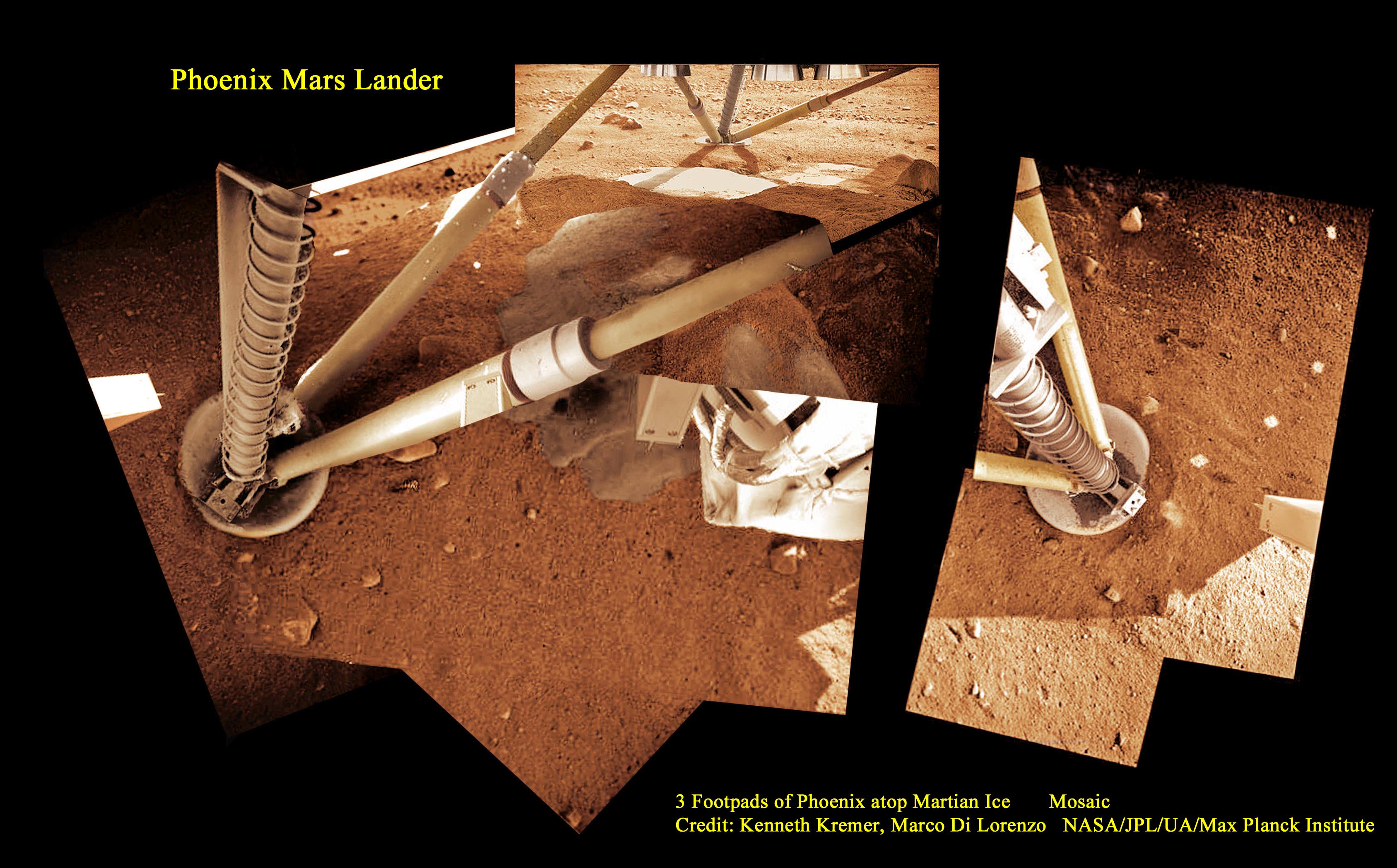
(it is not dated 1st of April, i must add)
Thank you very much EarthlingX.
I really hope that Phoenix Mars Lander does reawaken.
Yes next passive listening campaign is from Monday 5th (my 41st) to Friday 9th April 2010 inclusive, with Mars Odyssey. There will be another around the Martian Northern Summer Solstice on: Thursday 13th May 2010.
I can see phoenix Mars Lander being hailed if she does not reawaken with Lazarus. I wonder if MRO & Mars Express are being used also?
NASA / JPL article here.
Andrew Brown.
Phoenix Mars Lander gets one last chance to use Lazarus Mode before being hailed.
Mars Odyssey will be listening out for Phoenix Mars Lander between today (Monday 5th April 2010) to Friday 9th April 2010.
If Phoenix fails to 'phone home', then there is a chance of a further campaign around the Martian northern Summer Solstice on Thursday 13th May 2010, though it seems more likely a hailing campaign may be attempted to awaken the lander in Scandia Colles. Apparently ESA have offered the use of Mars Express in any hailing campaign, so there will be a minimum of two orbiters involved.
We will definately know for 100% sure if Mars Odyssey & Mars Express get no response.
I suspect Phoenix Mars Lander is dead & damaged beyond use, due to the minus 140 Celsius of the Scandia Colles Winter, but we'll see.
Perhaps like the legendary bird, The Phoenix will arise again, not from the fire this time, but from the cryonic cold of the Martian Winter!!!!!!

Andrew Brown.
Mars Odyssey will be listening out for Phoenix Mars Lander between today (Monday 5th April 2010) to Friday 9th April 2010.
If Phoenix fails to 'phone home', then there is a chance of a further campaign around the Martian northern Summer Solstice on Thursday 13th May 2010, though it seems more likely a hailing campaign may be attempted to awaken the lander in Scandia Colles. Apparently ESA have offered the use of Mars Express in any hailing campaign, so there will be a minimum of two orbiters involved.
We will definately know for 100% sure if Mars Odyssey & Mars Express get no response.
I suspect Phoenix Mars Lander is dead & damaged beyond use, due to the minus 140 Celsius of the Scandia Colles Winter, but we'll see.
Perhaps like the legendary bird, The Phoenix will arise again, not from the fire this time, but from the cryonic cold of the Martian Winter!!!!!!
Andrew Brown.
Has there been any further news on the final attempt to hear from Phoenix over the period May 17th to 21st (just after the Northern Mars summer solstice) which was described here:
http://www.nasa.gov/mission_pages/phoen ... 00513.html
:?:
Looks very much (as expected) Phoenix RIP. 🙁 Still a very successful mission though! 🙂
http://www.nasa.gov/mission_pages/phoen ... 00513.html
:?:
Looks very much (as expected) Phoenix RIP. 🙁 Still a very successful mission though! 🙂
newtons_laws":cspgx0iz said:
NASA Declares Mars Lander Broken and Dead
By SPACE.com Staff
NASA's long-dormant Phoenix Mars Lander is broken and officially down for the count, with new images taken by an orbiting probe showing severe damage to the spacecraft's solar panels due to the harsh Martian winter.
Repeated attempts by NASA in recent months to reestablish contact with Phoenix following its winter hibernation were unsuccessful, with no peeps coming from the lander.
The new photos of Phoenix, sent by NASA's Mars Reconnaissance Orbiter, indicate that the lander has suffered severe ice damage to at least one of its solar panels, NASA officials said Monday.
http://www.space.com/missionlaunches/ph ... t=My+Yahoo
The NASA article below reads pretty much trhe same as the excellent Space.Com one on our front page.
NASA article.
Yep I can see the craft is severly damaged, even being only a few pixels wide in the MRO HiRISE, considerable damage is apparent.
I know the Phoenix Mars Lander very well & looking more closely I think the actualy lander herself has twisted, I.E the eastern panel, still attached looks as though it is aligned more to the ESE than earlier on. IMO the entire craft has either shunted or twisted a few degrees to the NW - SE alignment. Mind you it is difficult to tell for sure if the deck has accumulated dust.
Also we cannot tell if the Stereo Surface Imager, or the Robotic Arm are still attached or snapped off.
Left 2008, right May 2010.

MRO HiRISE entry.
Below. Lander, Heat Shield impact site & Parachute / backshell. Parachute is completely covered in dust, the backshell is still visible. The Heat Shield still casts a shadow but it's impact scar has gone

Andrew Brown.
NASA article.
Yep I can see the craft is severly damaged, even being only a few pixels wide in the MRO HiRISE, considerable damage is apparent.
I know the Phoenix Mars Lander very well & looking more closely I think the actualy lander herself has twisted, I.E the eastern panel, still attached looks as though it is aligned more to the ESE than earlier on. IMO the entire craft has either shunted or twisted a few degrees to the NW - SE alignment. Mind you it is difficult to tell for sure if the deck has accumulated dust.
Also we cannot tell if the Stereo Surface Imager, or the Robotic Arm are still attached or snapped off.
Left 2008, right May 2010.
MRO HiRISE entry.
Below. Lander, Heat Shield impact site & Parachute / backshell. Parachute is completely covered in dust, the backshell is still visible. The Heat Shield still casts a shadow but it's impact scar has gone
Andrew Brown.
Toast is toast 🙂
MeteorWayne":tppwefik said:
Pretty much. A toast to the success would be appropriate though.
If nothing else it shows how much be know about the environment of Mars and can infer our abil;ity to live and work there. The Rovers were put in a much more benign environment and have survive well past their expectations, Phoenix well exceeded it's intended mission and a lot more. That it would survive was always a long shot but always presented as such.
What a dynmaic environment. The lander "reconfigured", the parachute and impact scar carried, dirt rearranged on the back shell. No wonder MPL has proved impossible to find.
How much is due to ice and snow and how much to wind?
How much is due to ice and snow and how much to wind?
Original thread: https://forums.space.com/threads/phoenix-mars-lander.1056/