WISE Mission Thread; Launched Dec 14
International Space Stationhttp://www.planetary.org : Progress on WISE's asteroid survey
WISE's scan of 50% of the sky for asteroids and comets
This image shows asteroids observed as of May 24, 2010, by NASA's Wide-field Infrared Survey Explorer, or WISE. As WISE scans the sky from its polar orbit, more and more asteroids and comets are caught in its infrared vision. The mission had surveyed about three-fourths of the sky to date; however, data for only about 50 percent of the sky had been processed for asteroids and comets. Credit: NASA / JPL-Caltech / UCLA / JHU

wise.ssl.berkeley.edu : May 24, 2010 - Heart and Soul Nebulae
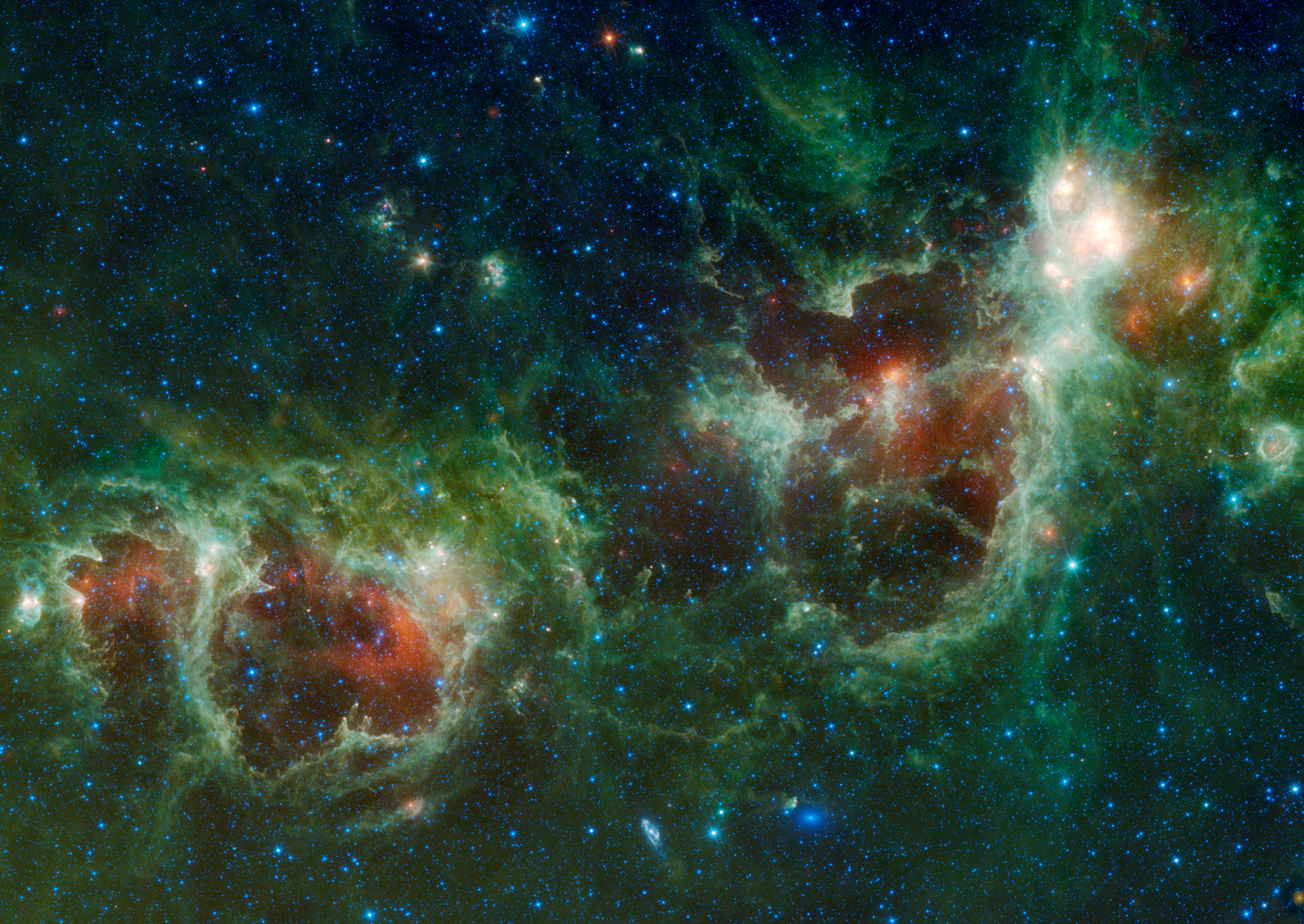
The Heart and Soul nebulae are seen in this infrared mosaic from NASA’s Wide-field Infrared Survey Explorer, or WISE. The image covers an area of the sky over ten times as wide as the full moon, and eight times as high (5.5 x 3.9 degrees), in the constellation Cassiopeia.


Interesting photo. So that dust trail encircles the sun?
No it doesn't. It's an effect of perspective.Fomalhautian":2svituhg said:
From:
http://www.daviddarling.info/encycloped ... itail.html
Part of the dust tail of a comet that seems to point, often like a spike, toward the Sun. This rare phenomenon is an illusion caused by the viewing geometry and typically occurs when Earth crosses the plane of a comet's orbit when the comet is relatively close to the Sun. Under these circumstances, the cometary dust, which lies in a thin sheet and lags behind the comet, may be seen edge-on as an antitail. One of the most prominent antitails ever seen was that of comet Arend-Roland during its perihelion passage in 1957.
From:
http://www.aerith.net/comet/weekly/current.html
Comet 65P/Gunn (6.80 year period)
Now it is visible visually at 12.3 mag (May 22, Juan Jose Gonzalez). It will brighten up to 12-13 mag in summer. But it locates somewhat low in the Northern Hemisphere.
Date(TT) R.A. (2000) Decl. .... Delta .. r .. Elong. m1 Best Time(A, h)
June 5 ... 21 12.14 ... -26 34.6 1.830 2.510 121 12.9 3:01 (340, 26)
June 12 ..21 14.54 ...-27 10.4 1.772 2.520 127 12.9 2:59 (346, 26)
JPL sbdb page:
http://ssd.jpl.nasa.gov/sbdb.cgi?sstr=6 ... ;cad=1#cad
Gary Kronk's Cometography page:
http://cometography.com/pcomets/065p.html
I pulled this quote from the link above the picture:

So I'm thinking it might encircle the sun. But looking at the similarities between pictures of the anti-tail on Arend-Roland and the Gun comet, they look almost identical.
The thing about dust ejected by comets is that it's only dense near perihelion where it is ejected on each orbit. After that, each particle takes it's own orbit. Those ejected in the opposite direction from the comet's motion move slower and are in smaller (and shorter period) orbits. Those ejected ahead move faster and are in larger (and longer) orbits. The only time the dust trails come together is near perihelion, but they will arrive at different times. So while there is a "dust trail" near the comet's orbit, except when near perihelion it's very dispersed.
Then various effects start to remove the smaller dust particles, such as the solar wind and the Poynting Robertson effect. So only close to the comet's perihelion is the trail dense enough to notice. For those trails where perihelion is near earth, when we plow through them we get our meteor showers.
There are one or two exceptions where objects have broken up and shed enormous amounts of dust, but are mostly larger particles of asteroidal origin..
Thanks Wayne. Great explanation.
wise.ssl.berkeley.edu : V385 Carinae - Jumbo Jellyfish or Massive Star?
June 17, 2010
Some might see a blood-red jellyfish in a forest of seaweed, while others might see a big, red eye or a pair of lips. In fact, the red-colored object in this new infrared image from NASA's Wide-field Infrared Survey Explorer (WISE) is a sphere of stellar innards, blown out from a humongous star.

Image Credit: NASA/JPL-Caltech/WISE Team
The star (white dot in center of red ring) is one of the most massive stellar residents of our Milky Way Galaxy. Objects like this are called Wolf-Rayet stars, after the astronomers who found the first few, and they make our Sun look puny by comparison. Called V385 Carinae, this star is 35 times as massive as our Sun, with a diameter nearly 18 times as large. It's hotter, too, and shines with more than one million times the amount of light.
Fiery candles like this burn out quickly, leading short lives of only a few million years. As they age, they blow out more and more of the heavier atoms cooking inside them -- atoms such as oxygen that are needed for life as we know it.
The material is puffed out into clouds like the one that glows brightly in this WISE image. In this case, the hollow sphere showed up prominently only at the longest of four infrared wavelengths detected by WISE. Astronomers speculate this infrared light comes from oxygen atoms, which have been stripped of some of their electrons by ultraviolet radiation from the star. When the electrons join up again with the oxygen atoms, light is produced that WISE can detect with its 22-micron infrared light detector. The process is similar to what happens in fluorescent light bulbs.
[youtube]http://www.youtube.com/watch?v=sJmCG9TG5Iw[/youtube]
http://www.jpl.nasa.gov : NASA's WISE Mission to Complete Extensive Sky Survey
SDC : Prolific NASA Sky-Mapper Finds 25,000 Hidden Asteroids
July 16, 2010
This image shows the famous Pleiades cluster of stars as seen through the eyes of WISE, or NASA's Wide-field Infrared Survey Explorer. The mosaic contains a few hundred image frames -- just a fraction of the more than one million WISE has captured so far as it completes its first survey of the entire sky in infrared light. Image credit: NASA/JPL-Caltech/UCLA
PASADENA, Calif. -- NASA's Wide-field Infrared Survey Explorer, or WISE, will complete its first survey of the entire sky on July 17, 2010. The mission has generated more than one million images so far, of everything from asteroids to distant galaxies.
"Like a globe-trotting shutterbug, WISE has completed a world tour with 1.3 million slides covering the whole sky," said Edward Wright, the principal investigator of the mission at the University of California, Los Angeles.
Some of these images have been processed and stitched together into a new picture being released today. It shows the Pleiades cluster of stars, also known as the Seven Sisters, resting in a tangled bed of wispy dust. The pictured region covers seven square degrees, or an area equivalent to 35 full moons, highlighting the telescope's ability to take wide shots of vast regions of space.

SDC : Prolific NASA Sky-Mapper Finds 25,000 Hidden Asteroids
By Denise Chow
SPACE.com Staff Writer
posted: 16 July 2010, 02:56 pm ET
A prolific NASA sky-mapping telescope will complete its first full survey of the sky Saturday, having beamed back to Earth more than a million images of everything from asteroids and comets to distant galaxies – some previously unseen until now.
"The primary goal of the mission is to do an all-sky survey in the thermal infrared with much higher sensitivity than has ever been done before," Edward Wright, the principal investigator of the mission at the University of California, Los Angeles, told SPACE.com. "We're succeeding in that."

Doesn't say much about that couple dozen brown dwarfs they found.
Next May ..
Until then they will release many images, like this one :
PIA13121: Seven Sisters Get WISE

Check this image in the highest resolution (linked under above image), and you will notice a lot of dim red spots between brighter stars. I had problem finding spot on this image without them, so i guess there will be plenty more red dwarves than just a dozen.
There is now a page at JPL with WISE asteroid (NEA+PHA) and comet discovery statistics.
These tables show discovery statistics for NEAs and comets discovered by NASA's WISE mission. The first small table shows the number of NEAs, PHAs (a sub-group of NEAs), and comets discovered to-date (within a day or two). The second table shows each object discovered, sorted by designation, with selected parameters describing the object's orbit.
Discovery Totals
NEAs: 100
PHAs: 15
Comets: 15
Total: 115
http://neo.jpl.nasa.gov/stats/wise/
Wide-Field Infrared Survey Explorer Mission Status
NASA's Wide-field Infrared Survey Explorer, or WISE, is warming up. Team members say the spacecraft is running out of the frozen coolant needed to keep its heat-sensitive instrument chilled.
The telescope has two coolant tanks that keep the spacecraft's normal operating temperature at 12 Kelvin (minus 438 degrees Fahrenheit). The outer, secondary tank is now depleted, causing the temperature to increase. One of WISE's infrared detectors, the longest-wavelength band most sensitive to heat, stopped producing useful data once the telescope warmed to 31 Kelvin (minus 404 degrees Fahrenheit). The primary tank still has a healthy supply of coolant, and data quality from the remaining infrared detectors remains high.
WISE completed its primary mission, a full scan of the entire sky in infrared light, on July 17, 2010. The mission has taken more than 1.5 million snapshots so far, uncovering hundreds of millions of objects, including asteroids, stars and galaxies. It has discovered more than 29,000 new asteroids to date, more than 100 near-Earth objects and 15 comets.
http://www.nasa.gov/mission_pages/WISE/ ... 00810.html
SDC : New Cosmic Photo Reveals Eye-Catching Rosette Nebula
wise.ssl.berkeley.edu : Aug 25, 2010 - WISE Captures the Unicorn's Rose
By SPACE.com Staff
posted: 27 August 2010
08:30 am ET
A NASA space telescope has snapped a stunning photo of a huge, flower-shaped cloud of dust and gas about 5,000 light-years from Earth.
The Wide-field Infrared Survey Explorer (WISE) captured the new cosmic photo of the star-forming Rosette nebula, which is in the constellation Monoceros (or Unicorn) in our Milky Way galaxy.

wise.ssl.berkeley.edu : Aug 25, 2010 - WISE Captures the Unicorn's Rose
Unicorns and roses are usually the stuff of fairy tales, but a new cosmic image taken by NASA’s Wide-field Infrared Explorer (WISE) shows the Rosette nebula located within the constellation Monoceros, or the Unicorn.
This flower-shaped nebula, also known by the less romantic name NGC 2237, is a huge star-forming cloud of dust and gas in the Milky Way Galaxy. Estimates of the nebula’s distance vary from 4,500 to 5,000 light-years away.
At the center of the flower is a cluster of young stars called NGC 2244. The most massive stars produce huge amounts of ultraviolet radiation, and blow strong winds that erode away the nearby gas and dust, creating a large, central hole. The radiation also strips electrons from the surrounding hydrogen gas, ionizing it and creating what astronomers call an HII region.

wise.ssl.berkeley.edu : A Nebula by Any Other Name
Also slight change in WISE Discovery Statistics :
There's more, including various image options and data.Sep 16, 2010
Nebulae are enormous clouds of dust and gas occupying the space between the stars. Some have pretty names to match their good looks, such as the Rose nebula, while others have much more utilitarian names. Such is the case with LBN 114.55+00.22, seen here in an image from NASA’s Wide-field Infrared Survey Explorer, or WISE.
Named after the astronomer who published a catalogue of nebulae in 1965, LBN stands for “Lynds Bright Nebula." The numbers 114.55+00.22 refer to nebula’s coordinates in the Milky Way Galaxy, serving as a sort of galactic home address.
Astronomers classify LBN 114.55+00.22 as an emission nebula. Unlike a reflection nebula, which reflects light from nearby stars, an emission nebula emits light. High-energy light blasted out from a nearby massive star strips away electrons from the nebula’s hydrogen gas, causing the gas to become charged. These nebulae are also called HII regions, with the “H” standing for hydrogen and the “II” indicating that the gas is ionized. As the ionized gas begins to cool from a higher-energy state to a lower-energy state, it glows. In the case of LBN 114.55+00.22, dust blocks the view of most of this nebula in visible light. But the dust of the nebula is also warmed by the light of the young stars within, and WISE’s infrared detectors see its beautiful infrared colors. Emission nebulae are usually found in the disks of spiral galaxies, and are places where new stars are forming.
In the lower left corner of the image is the bright red star IRAS 23304+6147, which is in the last phase of its life. As the hydrogen in its core burns out, the star will become a planetary nebula, ejecting material that absorbs visible light and glows in the infrared. This star’s name comes from the 1983 survey mission Infrared Astronomical Satellite (IRAS).
Another bright object in this image is the supergiant variable star HIP 117078, seen above and to the right of the nebula. In this case, HIP stands for Hipparcos, a European Space Agency satellite that catalogued the positions of over 100,000 stars.
The colors used in this image represent specific wavelengths of infrared light. Blue and cyan represent light emitted at wavelengths of 3.4 and 4.6 microns, which is predominantly from stars. Green and red represent light from 12 and 22 microns, respectively, which is mostly emitted by dust.
Image Credit: NASA/JPL-Caltech/WISE Team

Also slight change in WISE Discovery Statistics :
wise.ssl.berkeley.edu : Reflection Nebula DG 129 and Pi Scorpii
...Sep 21, 2010
In the Grip of the Scorpion’s Claw
Gripped in the claw of the constellation Scorpius, sits the reflection nebula DG 129, a cloud of gas and dust that reflects light from nearby, bright stars. This infrared view of the nebula was captured by NASA’s Wide-field Infrared Survey Explorer, or WISE.
Viewed in visible light, this portion of the sky seems somewhat unremarkable. But in infrared light, a lovely reflection nebula is revealed. DG 129 was first catalogued by a pair of German astronomers, named Johann Dorschner and Josef Gürtler, in 1963.
Much like gazing at Earth-bound clouds, it is fun to use your imagination when looking at images of nebulae. Some people see this nebula as an arm and hand emerging from the cosmos. If you picture the "thumb" and "forefinger" making a circle, it is as though you are seeing a celestial "okay" sign.
The bright star on the right with the greenish haze is Pi Scorpii. This star marks one of the claws of the scorpion in the constellation Scorpius. It is actually a triple-star system located some 500 light-years away. Perhaps a cross-species celestial handshake is imminent?
The colors used in this image represent different wavelengths of infrared light. The image was constructed from frames taken after WISE ran out of some of the coolant needed to chill its infrared detectors and began to warm up. The WISE detector sensitive to 22-micron light has become too warm to produce good images, but the three shorter wavelength detectors continue to crank out over 7,000 pictures of the sky every day, like the ones that make up this picture .Blue represents infrared radiation at 3.4 microns, while green represents light with a wavelength of 4.6 microns. Red represents 12-micron infrared light.
Image Credit: NASA/JPL-Caltech/WISE Team

Interesting update.
This animation demonstrates how the Wide-field Infrared Survey Explorer, or WISE, surveys asteroids and comets in the solar system. The project to hunt for asteroids and comets -- including near-Earth objects, or NEOs -- using the WISE data is called NEOWISE.
The perspective shown here is loo......
Asteroid and Comet Census from WISE.

NASA/JPL-Caltech/UCLA/JHU.
Andrew Brown.
This animation demonstrates how the Wide-field Infrared Survey Explorer, or WISE, surveys asteroids and comets in the solar system. The project to hunt for asteroids and comets -- including near-Earth objects, or NEOs -- using the WISE data is called NEOWISE.
The perspective shown here is loo......
Asteroid and Comet Census from WISE.
NASA/JPL-Caltech/UCLA/JHU.
Andrew Brown.
From Andrew's link above:
"As of Oct. 4, 2010, the project has observed more than 150,000 main belt asteroids and discovered more than 33,500. It has observed 452 near-Earth objects and discovered 118. It has also observed 110 comets and discovered 19."
"As of Oct. 4, 2010, the project has observed more than 150,000 main belt asteroids and discovered more than 33,500. It has observed 452 near-Earth objects and discovered 118. It has also observed 110 comets and discovered 19."
I agree Wayne, impressive set of statistics.
The frozen Hydrogen (Hydrogen Ice) coolant has run out & WISE has 'warmed' up. NASA will continue the mission using WISE at shorter IR wavelengths, enabling further comet & asteroid observations & discoveries, as well as the search for 'close' brown dwarves will continue, the possiblity that WISE could still find one or more closer than the Alpha Centauri system.
Andrew Brown.
Impressive mission, like an asteroid/comet vacuum cleaner 😉
JPL article about WISE warming up, but still holding the post :
http://www.jpl.nasa.gov : NASA's WISE Mission Warms Up but Keeps Chugging Along
It's also used to help other missions :
http://www.jpl.nasa.gov : WISE Captures Key Images of Comet Mission's Destination
SDC : New Comet Photos Show Icy Target for NASA Probe
JPL article about WISE warming up, but still holding the post :
http://www.jpl.nasa.gov : NASA's WISE Mission Warms Up but Keeps Chugging Along
It's also used to help other missions :
http://www.jpl.nasa.gov : WISE Captures Key Images of Comet Mission's Destination
...October 05, 2010
This visitor from deep space, seen here by NASA's Wide-field Infrared Survey Explorer, or WISE, is comet Hartley 2 -- the destination for NASA's EPOXI mission. Image credit: NASA/JPL-Caltech/UCLA
PASADENA, Calif. -- NASA's Wide-field Infrared Survey Explorer, or WISE, caught a glimpse of the comet that the agency's EPOXI mission will visit in November. The WISE observation will help the EPOXI team put together a large-scale picture of the comet, known as Hartley 2.
"WISE's infrared vision provides data that complement what EPOXI will see with its visible-light and near-infrared instruments," said James Bauer, of NASA's Jet Propulsion Laboratory, Pasadena, Calif. "It's as if WISE can see an entire country, and EPOXI will visit its capital."
WISE's infrared vision will allow the telescope to get a new estimate of the size of the comet's nucleus, or core, as well as a more thorough look at the sizes of dust particles that surround it. This information, when combined with what EPOXI finds as it gets closer to Hartley 2, will reveal how the comet has changed over time.
The WISE image is available at: http://photojournal.jpl.nasa.gov/catalog/PIA13438.

...
...
SDC : New Comet Photos Show Icy Target for NASA Probe
wise.ssl.berkeley.edu : The Many Infrared 'Personalities' of the Sculptor Galaxy
Oct 13, 2010
Image Credit: NASA/JPL-Caltech/WISE Team
The Sculptor galaxy is shown in different infrared hues, in this new mosaic from NASA's Wide-field Infrared Survey Explorer, or WISE. The main picture is a composite of infrared light captured with all four of the space telescope's infrared detectors.
The red image at bottom right shows the galaxy's active side. Infant stars are heating up their dusty cocoons, particularly in the galaxy's core, making the Sculptor galaxy burst with infrared light. This light -- color-coded red in this view -- was captured using WISE's longest-wavelength, 22-micron detector. The dusty burst of stars is so intense in the core that it generates diffraction spikes. Diffraction spikes are telescope artifacts normally seen only around very bright stars.
The green image at center right reveals the galaxy's emerging young stars, concentrated in the core and spiral arms. Ultraviolet light from these hot stars is being absorbed by tiny dust or soot particles left over from their formation, making the particles glow with infrared light that has been color-coded green in this view. WISE can see this light with a detector designed to capture wavelengths of 12 microns.
The blue image at top right was taken with the two shortest-wavelength detectors on WISE (3.4 and 4.6 microns). It shows stars of all ages, which can be found not just in the core and spiral arms but throughout the galaxy.
The Sculptor galaxy, or NGC 253, was discovered in 1783 by Caroline Herschel, a sister and collaborator of the discoverer of infrared light, Sir William Herschel. It was named after the constellation in which it is found, and is part of a cluster of galaxies known as the Sculptor group. The Sculptor galaxy can be seen by observers in the southern hemisphere with a pair of good binoculars.
NGC 253 is an active galaxy, which means that a significant fraction of its energy output does not come from normal populations of stars within the galaxy. The extraordinarily high amount of star formation occurring in the nucleus of this galaxy has led astronomers to classify it as a "starburst" galaxy. At a distance of approximately 10.5 million light-years away, NGC 253 is the closest starburst galaxy to our Milky Way Galaxy. However, the starburst alone cannot explain all the activity observed in the nucleus. One strong possibility is that a giant black hole lurks at the heart of it all, similar to the one that lies at the center of the Milky Way.
In late September of this year, after surveying the sky about one-and-a-half times, WISE exhausted its supply of the frozen coolant needed to chill the longest-wavelength detectors -- the 12- and 22-micron channels. The satellite is continuing to survey the sky with its two remaining detectors, focusing primarily on asteroids and comets. Read more about this survey, called the NEOWISE Post-Cryogenic mission, at jpl.nasa.gov.

http://www.jpl.nasa.gov : Cool Star is a Gem of a Find
...November 09, 2010
That green dot in the middle of this image might look like an emerald amidst glittering diamonds, but it is actually a dim star belonging to a class called brown dwarfs. This particular object is the first ultra-cool brown dwarf discovered by WISE. Image credit: NASA/JPL-Caltech/UCLA
NASA's Wide-field Infrared Survey Explorer, or WISE, has eyed its first cool brown dwarf: a tiny, ultra-cold star floating all alone in space.
WISE is scanning the whole sky in infrared light, picking up the glow of not just brown dwarfs but also asteroids, stars and galaxies. It has sent millions of images down to Earth, in which infrared light of different wavelengths is color-coded in the images.
"The brown dwarfs jump out at you like big, fat, green emeralds," said Amy Mainzer, the deputy project scientist of WISE at NASA's Jet Propulsion Laboratory in Pasadena, Calif. Mainzer, who makes jewelry in her spare time, explained that the brown dwarfs appear like green gems in WISE images because the methane in their atmospheres absorbs the infrared light that has been coded blue, and because they are too faint to give off the infrared light that is color-coded red. The only color left is green.
Like Jupiter, brown dwarfs are made up of gas -- a lot of it in the form of methane, hydrogen sulfide, and ammonia. These gases would be deadly to humans at the concentrations found around brown dwarfs. And they wouldn't exactly smell pretty.
"If you could bottle up a gallon of this object's atmosphere and bring it back to Earth, smelling it wouldn't kill you, but it would stink pretty badly -- like rotten eggs with a hint of ammonia," said Mainzer.

...
Original thread: https://forums.space.com/threads/wise-mission-thread-launched-dec-14.21355/