What was the highest it ever went?
Question about the V-2
Our Solar SystemIIRC, Mach 3, also. Pretty intense for 1940's technology.<br /><br /> <div class="Discussion_UserSignature"> <p><font color="#ff0000"><strong>TPTB went to Dallas and all I got was Plucked !!</strong></font></p><p><font color="#339966"><strong>So many people, so few recipes !!</strong></font></p><p><font color="#0000ff"><strong>Let's clean up this stinkhole !!</strong></font> </p> </div>
That be how one gets so high.<br /><br /><img src="/images/icons/wink.gif" /><br /><br /> <div class="Discussion_UserSignature"> <p><font color="#ff0000"><strong>TPTB went to Dallas and all I got was Plucked !!</strong></font></p><p><font color="#339966"><strong>So many people, so few recipes !!</strong></font></p><p><font color="#0000ff"><strong>Let's clean up this stinkhole !!</strong></font> </p> </div>
That is far into space. I didn't know it went that high. Was this in Germany or in the US/USSR aftewr the war?<br /><br />By the way, what was the first vehicle to go above 100km.
<br />Yes I believe a V-2 was the first vehicle to go into what is considered space by the IFA. The US government and its services, military and civilian - NASA - accept 50 miles as the space boundary, not 62, which is 100km.<br /><br />I would recommend Space Race, a US/UK/Russian joint production tv programme about the post-war space race. A 'docudrama' it focuses as much on what went wrong as what went right.<br /><br />The V-2 was key for both sides but the Russians got hold of the engine specialists and took the key decision to integrate the tank and fuselagfe so saving weight. The R-4 being Russia's version of the V-2.
<blockquote><font class="small">In reply to:</font><hr /><p>Did the link work for you?<p><hr /></p></p></blockquote>Yes, but I found it difficult to follow so I thought I'd ask in case someone knew.<br /><br /><blockquote><font class="small">In reply to:</font><hr /><p>That was a science mission in the US.<p><hr /></p></p></blockquote>Thanks... <img src="/images/icons/smile.gif" /><br /><br /><blockquote><font class="small">In reply to:</font><hr /><p>Yes I believe a V-2 was the first vehicle to go into what is considered space by the IFA. The US government and its services, military and civilian - NASA - accept 50 miles as the space boundary, not 62, which is 100km.<p><hr /></p></p></blockquote>It seems it was the V-2 either way. I found that on the 18th of March 1943 one reached 95 km and in beginning of 1944 another reached 189 km.<br /><br />For some reason I have always believed that the V-2 never quite reached space and from television documentaries, while they always mention the V-2, you get the impression that the space age began with Sputnik. This is more impressive than I thought...
There was also a successfully tested A10/V3 capable of reaching the East coast of the USA.<br />It seems to be hidden history but if you speak Russian you may find something about it.<br />The Germans were way ahead in aircraft wing design & rocketry & I thank all for beating them having watched many the V1's going over
<blockquote><font class="small">In reply to:</font><hr /><p>There was also a successfully tested A10/V3 capable of reaching the East coast of the USA.<p><hr /></p></p></blockquote>Are you sure? I can't find any references of an A9/A10 even having been built.<br /><br /><blockquote><font class="small">In reply to:</font><hr /><p>It seems to be hidden history but if you speak Russian you may find something about it.<p><hr /></p></p></blockquote>I speak a few languages, but Russian is not among them.<br /><br /><blockquote><font class="small">In reply to:</font><hr /><p>The Germans were way ahead in aircraft wing design & rocketry & I thank all for beating them having watched many the V1's going over<p><hr /></p></p></blockquote>I have read that they were building a system for submarine launched V-2s.
I'm not aware of any V2 flights from Peenemunde that reached 100 km, though test 6 did reach 67 km. After the war the Von Braun team reached an altitude of 70 miles which is over 100 km with the third launch from White Sands on 10 May, 1946.<br /><br />
"About 353 Km. but that is not when it was used as a weapon. In that case the max altitude would be much lower. "<br /><br />Wasn't that a Bumper flight? On these the V2 was just the first stage and the WAC Corporal was the second stage and the part that actually reached the higher altitudes in the tests.<br /><br />
<blockquote><font class="small">In reply to:</font><hr /><p>I'm not aware of any V2 flights from Peenemunde that reached 100 km, though test 6 did reach 67 km.<p><hr /></p></p></blockquote>I found this on Encyclopedia Astronautica:<br /><br /><i>"Beginning of 1944 - Launch Site: Peenemuende . Launch Vehicle: V-2.<br /><br /> * V-2 sounding rockets Nation: Germany. Apogee: 189 km.<br /><br /> The Peenemuende team developed scientific payloads for a sounding rocket version of the V-2, to measure cosmic rays, meteoroid flux, and so on. However due to the pressure to solve the missile's reliability problems, these were never flown from Germany. Only after the war could these plans be implemented in New Mexico. However during the war there were some vertical shots of the missile to test its stability and behaviour in a vacuum. On one such shot the missile reached 189 km altitude. On another occasion four launch troops were killed when the missile ascended, then veered 90 degrees, turned again, and impacted in the launch pit at the point of launch. References: 693 ."</i><br /><br />http://www.astronautix.com/chrono/19441.htm
353 K. Holy Sh*t! That is amazing.<br /><br />Did anyone ever put a camera on one of those?
Mechanical film camera?
<blockquote><font class="small">In reply to:</font><hr /><p>Did anyone ever put a camera on one of those?<p><hr /></p></p></blockquote>That is a good question.<br /><br />I found these very good CGI renderings of an A9/A10 launch, by the way.<br /><br />http://www.luft46.com/jhart/jha9-1.jpg<br />http://www.luft46.com/jhart/jha9-2.jpg<br />http://www.luft46.com/jhart/jha9-3.jpg<br /><br />http://www.luft46.com/jhart/jha9.html
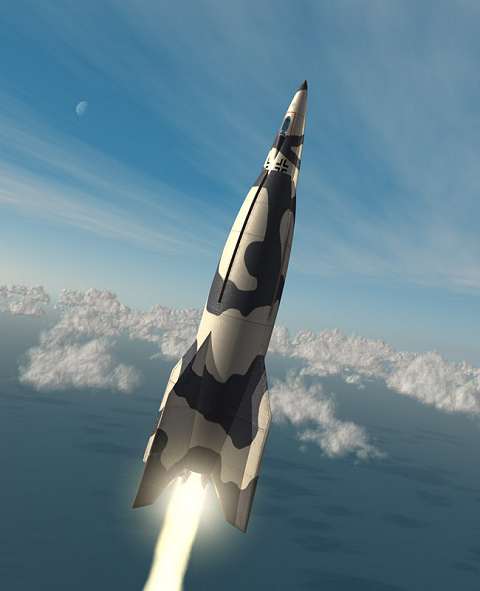


For years, the two-stage V-2/WAC Corporal flight was considered the first true rocket into space, as its apogee definitely was above all reasonable definitions of where space begins. By today's definition, the V-2 by itself made it. <br />I've never seen any info that the intercontinental successor to the V-2 was ever built. Anyone got any?
http://www.russianspaceweb.com/rockets_wwII_germany.html <div class="Discussion_UserSignature"> <p><em>Differential Diagnosis: </em>"<strong><em>I am both amused and annoyed that you think I should be less stubborn than you are</em></strong>."<br /> </p> </div>
<blockquote><font class="small">In reply to:</font><hr /><p>I've never seen any info that the intercontinental successor to the V-2 was ever built. Anyone got any?<p><hr /></p></p></blockquote>I have been searching the Internet and found rumours like this:<br /><br /><i>"The only rocket in Germany's armoury able to reach beyond the 200 miles of the V-2 carrying a one-tonne payload was the winged A9/A10. It was eighty feet long and coult hit New York. The series was not yet in mass production, the project having only been resurrected in December 1944. A test launch seems to have been carried through near Ohrdruf on March 16, 1945. At least four witnesses gave evidence that an "Amerika" rocket was launched succesfully from Polte II MUNA Rudisleben (an underground munitions factory site)."</i><br /><br />http://www.robsacc.nl/ottens/thirdreich_wonderweapons-vergeltungswaffen.html<br /><br />...but I suspect we are getting into Nazi foofighter territory here.
<i>...but I suspect we are getting into Nazi foofighter territory here.</i><br /><br /><blockquote><font class="small">In reply to:</font><hr /><p>By December 1944 when the Uraniumbombe was ready for use in numbers for the definitive V-2 campaign...<p><hr /></p></p></blockquote><br /><br />Clearly, yes, foofighter territory indeed. <div class="Discussion_UserSignature"> <p><em>Differential Diagnosis: </em>"<strong><em>I am both amused and annoyed that you think I should be less stubborn than you are</em></strong>."<br /> </p> </div>
The only confirmed launches related to the A9/10 I can find are the three A4b launches (two failiures and one mostly successful). These were A9 prototypes hidden under the designation A4b to secure funding.<br /><br />With regards to the earlier question about cameras I found this quote:<br /><br /><i>"When dozens of captured German V 2 rockets were launched at White Sands, New Mexico, from 1946 into the 1950s, at least one carried a black-and-white camera that photographed Earth's curvature."</i><br /><br />http://www.space.com/businesstechnology/technology/rocketcams_000315.html <br /><br />I wonder if the Germans ever tried it... ?
Several V2s carried cameras, here is a listing of the White Sands V2 launches and what the payloads were.<br />http://www.wsmr.army.mil/pao/FactSheets/V2/v-2tab.htm<br /><br />
Sure. In fact, here's one they didn't use that's still on display at Fort Bliss, El Paso Texas. I happened to be stationed there, a ways back. <div class="Discussion_UserSignature"> <p><em>Differential Diagnosis: </em>"<strong><em>I am both amused and annoyed that you think I should be less stubborn than you are</em></strong>."<br /> </p> </div>
I can't help thinking about Tintin when I look at the V-2 and especially the A9/A10 renderings.<br /><br />http://www.free-tintin.net/dessins/lune.jpg

TinTin and Asterix? <div class="Discussion_UserSignature"> <p><em>Differential Diagnosis: </em>"<strong><em>I am both amused and annoyed that you think I should be less stubborn than you are</em></strong>."<br /> </p> </div>
Asterix is fun too, but I don't think he ever went to the moon... <img src="/images/icons/wink.gif" />
Original thread: https://forums.space.com/threads/question-about-the-v-2.2960/